Personal & Household Questions
To report flooding, missing manholes or grates, hazardous spills, or illicit discharges, please contact the Warren Water Pollution Control Department.
During business hours (7:00 AM – 3:30 PM), call 330-841-2591.
After hours, call 330-307-4211.
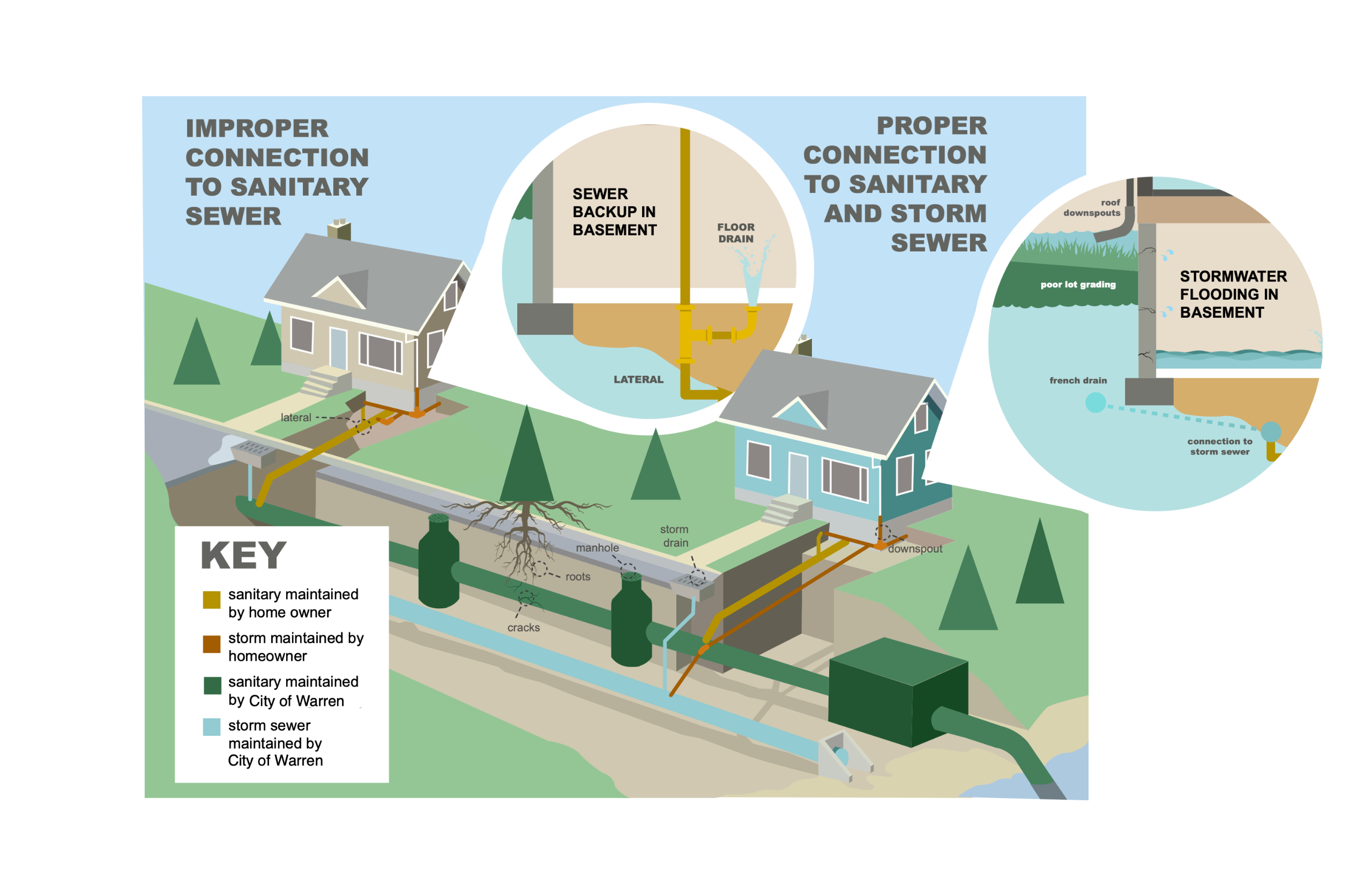
There are two types of flooding that can affect you: storm system flooding or sanitary system flooding. The focus of this project is on storm system flooding.
For more information, check out the page called "What We're Doing" and click on "Storm System Flooding vs. Sanitary Sewer Backups."
Simple things you can do around your home to prevent wet-weather related issues include:
- Install gutters and downspouts: Gutters and downspouts are your home's stormwater infrastructure to route flows away from your home and toward the street or your yard. It is recommended that you extend downspouts at least four feet away from your home so the flow doesn’t end up next to your basement walls or in your footer drains.
- Maintain ditches and inlets: When ditches and inlets are clogged, not only can it cause flooding for that resident, but for all residents upstream. Clogged ditches and inlets prevent the stormwater from flowing to where it needs to go - away from streets and homes and to the creek or river
- Pick up your leaves: Leaves clogging inlets is the most common maintenance issue for Warren's stormwater sewers. By raking and disposing of your leaves properly, you are preventing future clogging and possible flooding of your neighborhood. Please do not dispose of leaves or grass clippings in the sewer system!
- Disconnect downspouts, footer drains, and sump pumps from the sanitary sewer: Many rain-related problems for Warren residents are due to the over-burdened sanitary sewers. Sanitary sewers are not designed to carry stormwater, so when rain enters the system, it can cause backups in homes. Removing all stormwater connections to the sanitary sewers can help reduce basement backups.
For additional information on preventing flooding, check out this guide from FEMA for tips on how to protect your home from flooding: https://www.fema.gov/sites/default/files/documents/fema_protect-your-home-from-flooding-brochure_2020.pdf.
The City's laws currently prevent working on private property. This effort is focused on reducing flooding within public streets.
Property owners are responsible for maintaining ditches on their property.
The City of Warren runs a curbside leaf collection program every fall. To be picked up, leaves must be in biodegradable paper yard bags. For more information, visit warren.org/living/departments/trash-recycling. If leaves clogging storm sewer drains are causing other stormwater issues such as flooding, you may contact the Water Pollution Control Department.
In summer 2021, Warren experienced multiple back-to-back large storms that led to flooding across much of the City. August 2021 alone saw nearly 10 inches of rain, which is two and a half times the normal amount of rain for that month! There have not been any other storms of this intensity in the last few years. However, all it takes is a few back-to-back rainstorms to cause major street flooding and other problems for residents.
By finding and addressing stormwater problem areas, we can work together to reduce the impacts of heavy rains on resident safety in the future.
Stormwater System Questions
A hydraulic model is a series of mathematical equations that simulates how water flows through a storm sewer system. It helps engineers and scientists design sewer systems by understanding what happens to the system during rain events.
A hydraulic model needs good data to represent real-world conditions. The City of Warren Stormwater Planning project team is collecting data using rain gauges and sewer flow monitors throughout the City in order to improve the hydraulic model.
Clogged storm drains can contribute to some flooding issues. If a storm drain inlet is clogged, water cannot get from the street into the storm sewer system. Try to keep your neighborhood’s storm drains clear of trash, grass clippings, leaves, and other debris, to reduce flooding and avoid polluting the storm system.
Long-term drainage issues are solved by municipalities typically through a Comprehensive Planning Process in order to understand the problems City-wide.
To learn more, please visit the "What We're Doing" section of this site and click on "The Comprehensive Stormwater Planning Process".
To learn more about potential solutions to long-term drainage issues, see the "Stormwater Problems and Solutions" page.
Flow monitoring can tell us a lot about how water behaves in different areas. By collecting data on water volume, velocity, and the frequency of flows, we can:
- Better assess problems in the storm water system
- Identify flooding areas
- Plan stormwater projects
- Determine good solutions
- Evaluate a project's effectiveness