Expand the tabs below to learn more about this project.
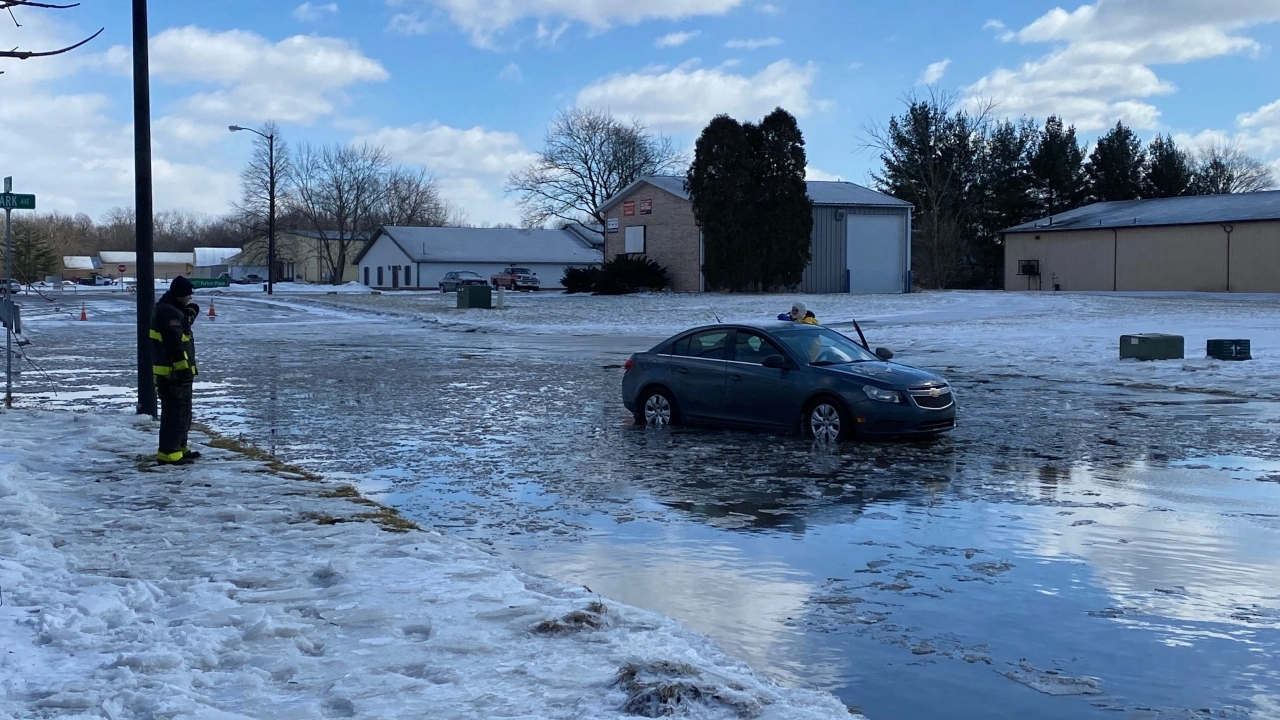
The City of Warren understands the negative impacts of flooded streets on not only the City's infrastructure and natural resources, but on the quality of life of Warren residents, workforce, and business owners.
Heavy rain and snow can cause street flooding that can prevent residents from making necessary trips to get to work or school, tend to their households, or perform caretaking duties. It can overburden police, fire and slow other safety services.
For those reasons, the City is focusing on addressing chronic street flooding in known areas.
Long-term drainage issues are solved by municipalities typically through a Comprehensive Planning Process in order to understand the problems City-wide.
Managing street flooding by evaluating the City’s complete storm system is necessary because water does not know neighborhood or Ward boundary lines – it goes where the land takes it. Often, addressing a problem in one area or neighborhood may accidentally move that problem downstream to the next neighborhood. This is why the City is developing this comprehensive approach, and why it takes time. The Warren Comprehensive Planning Effort will address flooding through planning, maintenance, and construction of stormwater related projects.
Comprehensive planning follows four steps:
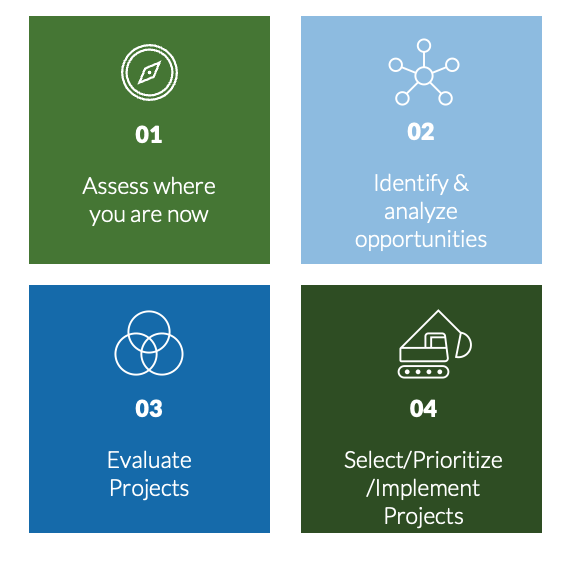
01. The first step in understanding the issues that cause street flooding is taking inventory and documenting the condition of existing infrastructure and waterways, including culverts and ditches, storm sewers and catch basins, and natural systems such as streams, floodplains, and greenspaces. Weather data, including rainfall, and flow monitoring data (i.e. the measurement of rain in the storm sewers) also needs to be collected to determine how the existing system responds during a storm.
02. Once data is collected, the City uses a hydraulic & hydrologic model to determine how the current stormwater system functions and where improvements are needed to minimize street flooding.
03. Projects identified will be evaluated based on other important factors, like cost, maintenance requirements, impacts to community members, environmental impact, etc.
04. Based on the evaluation criteria and the modeling, projects are selected that align with the capital improvements budget and prioritized based on need, cost, complexity, etc. The projects are then implemented.
To learn more about potential solutions, see the Stormwater Problems and Solutions page.
The City of Warren has been busy at work to understand where, how, and why flooding occurs throughout the city, and what can be done to fix it. The goals of this project are to:
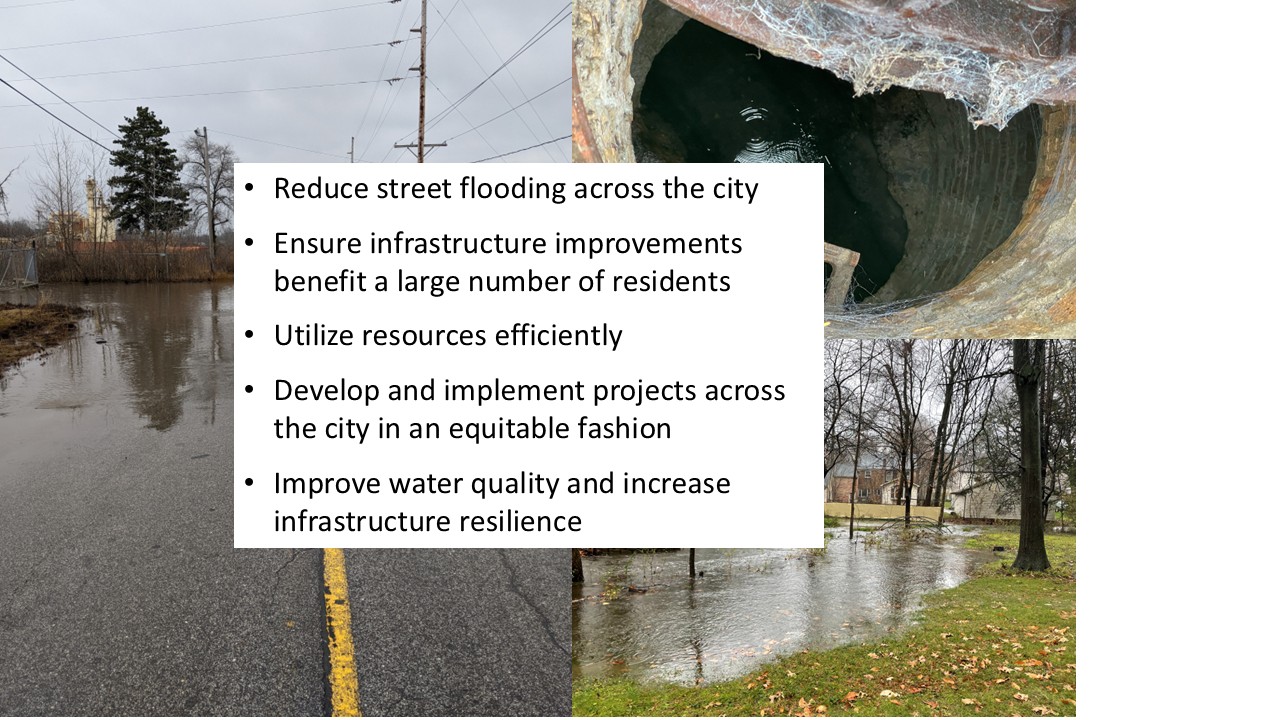
To accomplish this, a hydraulic & hydrologic model of all culverts and ditches, storm sewers and catch basins, and natural systems such as streams, floodplains, and greenspaces was developed for the City. This model predicted potential flooding hotspots based on sewer capacity limitations that were added to the list of community-reported locations. From there, rainfall and storm sewer data were collected, and any data gaps were investigated in the field to further refine the model.
Areas with reported flooding and those identified as high flood risk in the model were deemed "Focus Areas": There are currently 4 focus areas in the city. Each of these Focus areas will have projects designed for them that consist of one or more of the following solutions:
- Cleaning existing storm sewers
- Upsizing existing storm sewers
- Installing new storm sewers
- Installing new storm outfalls
- Installing stormwater detention practices
- Performing stream restoration
To learn more about these solutions, check out the "Stormwater Problems and Solutions" page!
To date, 75% of planned flow monitoring has been completed to improve the model, and 50% of the identified Focus Areas have had preliminary projects developed for them. While the rest of the data is being collected for the remaining model areas, The City of Warren is developing the next steps to begin implementing the identified projects.
There are two types of flooding that can affect you: storm system flooding or sanitary system flooding. The focus of this project is on storm system flooding.
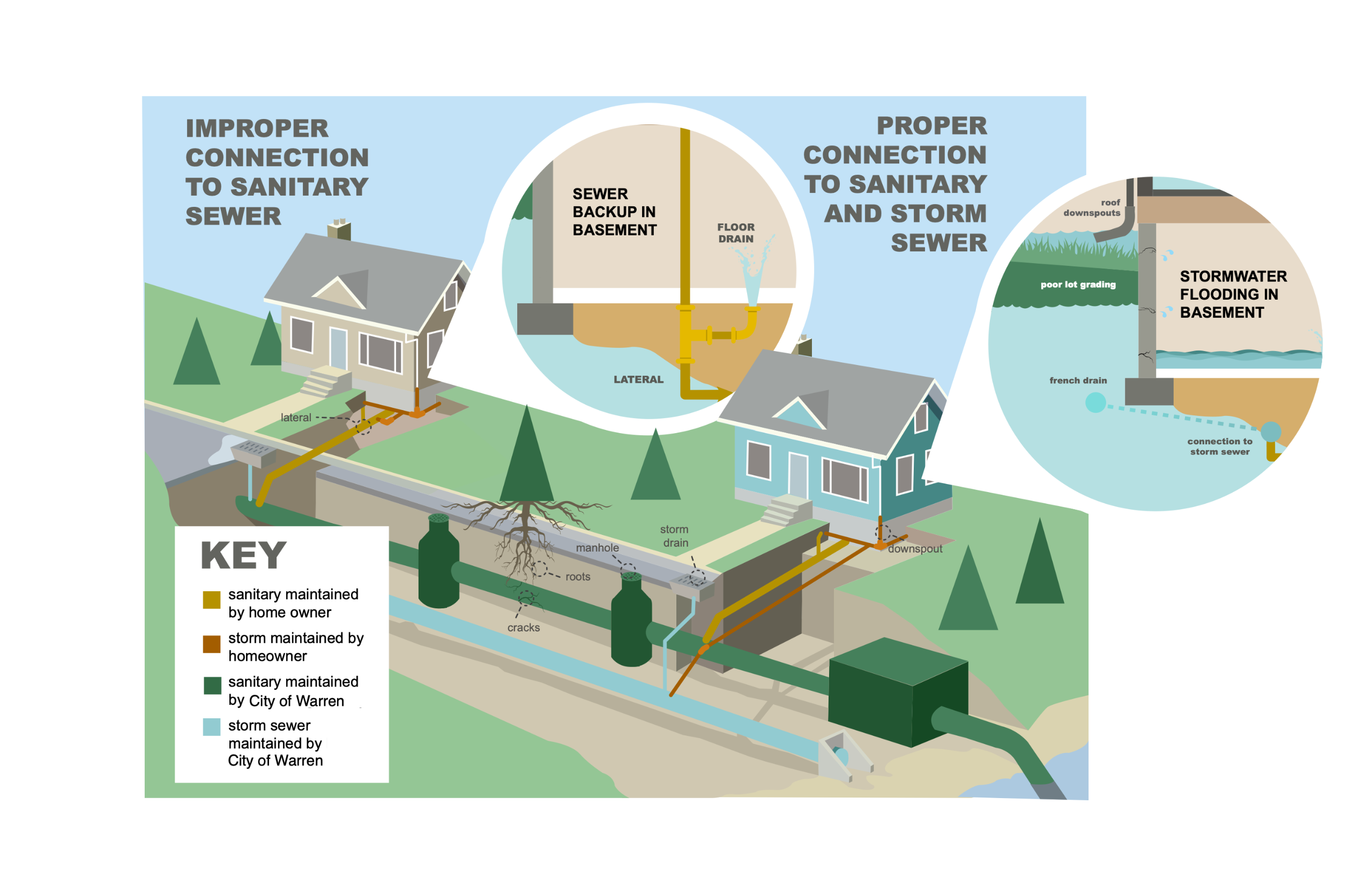
Any part of a building that catches rain or snow should discharge outside, or be connected to the stormwater system. This stormwater "catchment system" should include foundation drains, sump pumps, and downspout leaders.
Drains that take water from the inside of your home – such as sinks, showers, toilets, and washing machines – connect to your sanitary sewer lateral, which then connects to the City's sanitary sewer system.
So how can you identify which type of flooding might be impacting you or your home?
If the flooding is related to the storm system, you may experience:
- water seeping through your basement walls and/or windows
- surface water around your building's foundation
This can happen for several reasons, such as home age, inadequate waterproofing or a failure in your building's drainage system (a blocked foundation drain or downspout leader, a sump pump failure, or poor grade around your home's foundation).
If you experience the following, then you are dealing with a sanitary backup:
- water is coming up through your floor drains in the basement or garage
- water coming out of other sanitary facilities,
If water is coming out of the sump by your sump pump, you may need some help identifying the source. Sump pumps should be connected to the storm sewer, but many sump pumps were improperly connected to the sanitary sewer in the past. Call Water Pollution Control for assistance if needed.
While the City wishes we could address every issue for our residents and property owners, we are limited to the public domain. This includes storm and sanitary sewer mains, roads and streets, and other public infrastructure.
The City can address any issue that originates in the public domain because the City's budget is derived from public funds. If you believe your flooding issue is from street flooding coming onto your property, please report the flooding to Water Pollution Control.